Body Fat Percentage - The Best Way To Track Weight Loss
Body fat percentage is the best way to track weight loss...
Wait. What? I thought we were talking about losing weight?
Well, we are.
There are many ways to measure the success of your "weight loss" efforts. A few of them are:
- Total Body Weight,
- Body Mass Index (BMI),
- Body Fat Percentage,
- Waist Circumference and Waist to Hip Ratio, and
- Lean Body Mass.
Now, let's talk about why you should focus on your body composition...
Just think about it... You're at the beach, and you pull your shirt over your head. What do you look like?
Are you just a skinnier version of yourself? Or do you look sleek and sexy with a nice, flat belly?
Also, by focusing on losing fat and not muscle, you'll also help keep your basal metabolic rate running at it's most efficient, which is essentail for shedding fat as fast as possible!
Now, let me ask you this... if you could weight 5 or 10 pounds more, and have that ripped, toned body, or weight 10 pounds less and be what I call "skinny-fat," which would you choose?
The problem with weight loss is that you focus too much on the weight, and too little on how it's distributed on your body. When people say they want know how to lose weight, the really mean is that they want to know how to lose body fat.
And that's where how much fat you carry comes in.
What is Body Fat Percentage?
If you're like everyone else, you likely focus on the scale. After all, it's easy to measure. You stand on it, and there is a number.
But what does that number mean?
"To People Who Want To Burn Fat - But Can't Get Started"
FREE:Want to increase your fat burning?
Grab your complimentary subscription to Middle Management™ and get Ben's FatBurners 101™ videos now...
Module 1: Create a Concrete Plan with the 4 M's
Module 2: 4 Super Simple Ways to Stay Motivated
Module 3: Little Used Secret Burn More Fat 24-Hours Per Day
Module 4: 7 Easy Steps to Melting Fat Permanently
The subscription is FREE and only available through this offer.
Join below and receive your first lesson immediately without any delay.
Face it, that number on the scale only tells you how much gravity pulls on you. It says nothing about how you look in the mirror. Or how much fat or muscle mass you have on your frame.
Weight loss measures everything you lose, including muscle mass. It doesn't tell you what changes are really going on or how you're going to look on the beach.
So, if you want that dream body, you should choose the right measure. You should reduce body fat percentage,
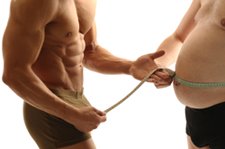
Think about a body builder. Take 2009 Mr. Olympia, Dexter Jackson, who is 5' 6" tall and competes at 233 pounds. His body fat percentage is close to 5%. He looks completely different than most other average 5'6", 230 pound males on the street, even though they weight the same, and it's all due to body fat percentage. Sure, you don't want to look like a bulked up body builder, but you get the point.
There is an old saying in the business world that goes like this...
"What gets measured gets managed."
And it's true.
What if you ran a business? Suppose that you decide that you want to focus on increasing revenue to make more money. What happens if your costs increase faster (due to marketing or other costs) than your revenue and you make less profit? Was revenue the right measure?
Imagine what it would be like if you only managed costs. You might decide that it's far cheaper to cut all advertising. Who would buy your product?
Just suppose you chose to watch only your price. Certainly, if you charge more per unit, your profits will rise, right? But what if you sell fewer units due to the increased price?
As you can see, measuring the right thing is hugely important. Obviously, in this example, you should measure "profit". Profit is made up of a combination of revenues and costs. Clearly, you can see that, by choosing the best measure, you'll also keep track of the measures that relate to profits as well - revenues and costs.
If you only measure your weight loss with the scale, then you'll focus only on that number, and not your shape.
However, if you focus on your ideal body fat percentage (and how to lose body fat), you'll focus more on your shape and you'll be much more likely to get the body you're really after.
What is the Ideal Body Fat Percentage?
First, you have to know that there are two types of fat:
Essential Fat
Source: American Council on Exercise
Storage Fat
From there, your ideal body fat percentage differs with gender. With that said, here is a really great body fat chart from the American Council on Exercise:
| Classification | Women (% fat) | Men (% fat) |
| Essential Fat | 10 to 12% | 2 to 4% |
| Athletes | 14 to 20% | 6 to 13% |
| Fitness | 21 to 24% | 14 to 17% |
| Acceptable | 25 to 31% | 18 to 25% |
| Obese | 32% + | 25% + |
How Do You Measure Body Fat Percentage?
Theoretically, to measure body fat percentage divide your fat weight by your total weight. Put another way, it is the portion of your body that is made up of the unhealthy, flabby, ugly stuff.
Luckily, there are a few ways you can measure body fat percentage. Keep reading...
Burn the Fat, Feed the Muscle by Tom Venuto
If you're interested in burning fat the natural way - without supplements, without drugs and without messing up your metabolism, then this will be the most important book you will ever read. Burn the Fat is the #1 best selling diet and fitness ebook in internet history, and for good reason. Tens of thousands of men and women in 135 countries have burned fat and gained muscle with these powerful, all-natural techniques... and you can too!
Water Displacement Method
Skin Fold Calipers
They kind of look like (to me, at least) lobster claws. You use them to measure the thickness of a pinch of skin at specific areas on your body. This estimates the amount of subcutaneous (below the skin) fat you have in each area.
Once you have the data, you put the info into a formula to get your body fat. Of course, there is some variation in the result depending on who is doing the test. However, if you use the same person and take the measurement in the same way each time, you should get a consistent result.
Bioelectrical Impedance Analysis (BIA)
Basically, in the home method, you stand with your feet on two conductors on top of the scale. Then, a small electric current is sent through you. Since fat, muscle mass and bone resist the current in different ways, your body fat can be estimated.
Formulas
 Finally, there are more than a few
formulas that you can use to estimate your body fat. For example, the U.S. Navy
and Army Body Fat Percentage formulas are fairly popular. They use neck, waist
and hip girth for women. For men, only neck and waist girth are used. Your
weight isn't used at all.
Finally, there are more than a few
formulas that you can use to estimate your body fat. For example, the U.S. Navy
and Army Body Fat Percentage formulas are fairly popular. They use neck, waist
and hip girth for women. For men, only neck and waist girth are used. Your
weight isn't used at all.
There are also other formulas that use things like your Body Mass Index (BMI), age, ethnicity or even the girth of other body parts to estimate your body fat percentage. You can often use a body fat calculator to do the heavy mathematical lifting for you.
Which Should You Use?
Whew! That's a lot of info! I know you're feeling a bit overwhelmed, because I certaily would be.
So which should you use?
You may think that you need to choose the most accurate method available. And most of the time, I would agree with you. However, in this case, the most accurate method is also the most inconvenient and most expensive.
I mean, can you see yourself going someplace to submerge yourself in a pool of water every week or so? I didn't think so.
So now what?
Remember why most people default to the scale. Because it's easy. But it doesn't always tell you when you've made good progress. You can lose fat and inches, and still gain weight if you put on muscle mass. This means that the scale is not "directionally accurate."
With that said, all of the methods listed above are directionally accurate. Therefore, I would choose the easiest method available.
If you are good with the skin fold calipers, then go with those to estimate your body fat percentage. However, if you're not, you can choose one of the formula methods (I've made it easy for you by creating a body fat calculator that uses the formulas).
Next Steps
What should you do next?
- Decide to Track Your Body Fat Percentage (instead of, or in
addition to, your weight)
-
Determine Your Ideal Body Fat Percentage Goal
-
Pick a Method to Measure Your Body Fat Consistently
-
-
Click the "Like" button.
Give us a +1.
Tweet About It
Tweet-
Let me know you're alive... Leave a comment below!
Leave "Body Fat Percentage" and Return Home




Get it FREE Below!


Over 76,524 Readers

